

The Final Performance Of These Legendary Acts
Ask any rock star (we're sure you're acquainted with several) if they prefer performing to recording, and it's pretty definite you'll get an affirmative response roughly 100% of the time. Making records can be a tedious process even when it's going really well, and for most performers, the stage is where they're in their element. They rock out with their buds in front of thousands of screaming fans, perhaps getting pelted with undergarments as they preside over a giant, raucous party in their honor before packing up to move out and do it again in a different town the next night.
The artists on this list are all legends, but even for them, the party had to wind down eventually. These are the final performances of some of the greatest acts of all time. While a few went out with a whimper instead of a bang, the vast majority of these curtain calls were suitably epic.
Warren Zevon
Warren Zevon was an absolute legend, and those who only know his name because of his borderline-novelty tune "Werewolves of London" are missing out big time. Any man who would write a spooky, eerie tune titled "Roland the Headless Thompson Gunner" in collaboration with an actual ex-mercenary is pretty cool in any book. And that's to say nothing of his brilliant songs that have become hits for the likes of Linda Ronstadt, Jackson Browne, and Bruce Springsteen.
Zevon was good buddies with David Letterman, even having sat in as bandleader a time or two in Paul Shaffer's absence. When he was diagnosed with terminal cancer in 2002, Letterman booked him for the entire hour, and it made for riveting television. Ever the straight shooter, Zevon was candid about his approaching death, gifting fans with one iconic piece of advice: "You're reminded to enjoy every sandwich." Zevon called Letterman "the best friend [his] music ever had," and in accordance with this, his appearance constituted his final public performance. Sprinkled throughout the hour, Zevon performed "Mutineer," "Genius," and — at Letterman's request — his signature tune, "Roland the Headless Thompson Gunner," with a visibly emotional Shaffer providing backup vocals.
The Cars
Boston-based new wave outfit the Cars had a relatively brief run, releasing six albums between 1978 and 1987 (and unexpectedly reuniting for a seventh, "Move Like This," in 2011). But the group's sound, rooted equally in the shredding guitar of Elliot Easton and the razor-sharp keyboard work of Greg Hawkes, was highly influential on their peers. Not to mention the contrasting lyrical and vocal styles of co-lead singers Ric Ocasek and Benjamin Orr provided an ever-shifting and always-interesting complement to the band's unique sonic palette.
Minus Orr, who died in 2000, the Cars mounted its final performance for a fitting occasion — the group's induction into the Rock & Roll Hall of Fame in 2017. With Weezer's Scott Shriner filling in for Orr on bass, the band performed a quartet of its most iconic hits: "My Best Friend's Girl," "You Might Think," "Moving in Stereo," and "Just What I Needed." At the time, Ocasek indicated that he almost enjoyed the experience enough to reconvene the band, with one understandable reservation. "Maybe this will be a good reason to do it again, though I really miss Ben as part of the thing," he said (via Rolling Stone). "As much as I want it to be The Cars and I love everyone so much in the Cars, without him it just feels different." Unfortunately, any chance of that happening came to an end just two years later, when Ocasek passed away in September 2019.
Nirvana
Nirvana was a legendarily powerful live band even when it was keeping things subdued, as during their iconic 1993 appearance on "MTV Unplugged." That set was the group's final widely seen performance, but it was followed by several dates in the U.S. and Europe. During the overseas leg, guitarist and singer Kurt Cobain was diagnosed with bronchitis and laryngitis. Despite the obvious problems this gave him, he disregarded doctors' advice to take a break and continued with the band's planned dates.
The concert that ended up being Nirvana's last took place on March 1, 1994, in an airplane hangar in Munich, Germany. The set was dragged down by poor acoustics, technical problems, and Cobain's obvious trouble with his vocals. For the band's encore, it performed the hit "Heart-Shaped Box," and by that time, Cobain was barely able to sing at all — he was forced to drop his voice an octave just to hit the proper notes in the chorus. Finally ready to acknowledge his struggles, Cobain allowed the remaining dates on the tour to be canceled, and that final lackluster performance became the swan song of one of the greatest rock bands of all time. Cobain died just over a month later on April 5, 1994.
Beastie Boys
When the Beastie Boys' "Licensed to Ill" became the first rap album ever to reach No. 1 on the Billboard chart, few expected the group to put together a long, fruitful career while earning the complete respect of their peers. And yet, that is exactly what the band did, displaying a remarkable ability to find fresh, inventive angles to their craft while staying totally true to their hip hop roots. Their 1989 sophomore effort "Paul's Boutique" constituted a 180-degree turnaround from its predecessor's sonic and lyrical simplicity, and it's widely regarded as a masterpiece. In 1992, "Check Your Head" saw the members picking up instruments to function as an actual band (and do it quite well).
By the time the Beasties played a barn-burning set at Bonnaroo in 2009, they were nothing less than hip hop elder statesmen. The group blazed through all the hits, from "No Sleep 'Til Brooklyn" to "Intergalactic" and the set-closing "Sabotage." Nobody expected the set to be their last, yet even then, Adam "MCA" Yauch was dealing with a pain in his throat that would, weeks later, be diagnosed as cancer of the salivary gland. In a statement, Yauch announced his intention to "get this in check" so the band could get back to performing — but it was not to be. The cancer proved to be aggressive, and Yauch passed away on May 4, 2012. Speaking with NME in 2015, Adam "Ad-Rock" Horovitz confirmed that Yauch's passing meant that the Beastie Boys were no more, saying, "Adam started the band, so we couldn't do anything without him."
Stevie Ray Vaughn
For those who appreciate the blues, deeply soulful guitar work, and brain-exploding talent, there are few guitar gods who are the equal of the late, great Stevie Ray Vaughn. His albums with his band Double Trouble, beginning with 1983's "Texas Flood," are masterful; he collaborated with such towering artists as James Brown, Dick Dale, and Bob Dylan; and he played lead on David Bowie's 1983 album "Let's Dance," the recording that made Bowie a massive international pop star. Vaughn was also an electrifying live performer, which he continually proved right up until the last night of his life.
Vaughn's final performance came on August 26, 1990, at the Alpine Valley Music Theater, a venue situated within the Alpine Valley ski resort in East Troy, Wisconsin. Vaughn and Double Trouble opened for Eric Clapton in front of roughly 40,000 fans, and that night's show concluded with an extended all-star blowout jam featuring Clapton, Vaughn and his brother Jimmie (the lead guitarist for the Fabulous Thunderbirds), and blues legends Robert Cray and Buddy Guy. Their final number, in a bittersweet piece of serendipity, was the blues standard "Sweet Home Chicago." Early the next morning, Vaughn boarded a helicopter bound for that very city. Not long after takeoff, the copter crashed into a ski hill in the foggy night, killing everyone on board.
Prince
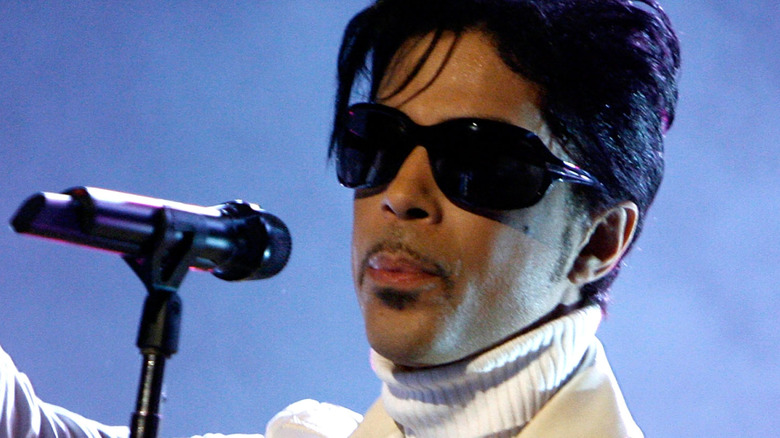
If humankind were to endeavor to select footage for a time capsule in order to illustrate for future civilizations what a rock star is, pretty much any clip of Prince in action would suffice. The Purple One not only embodied rock 'n' roll, he simply seemed to subsist on music. As one of the most insanely talented musicians to ever live, he habitually surrounded himself with prodigious talent when performing live, which makes his final tour — and performance — an interesting outlier.
Dubbed the "Piano & A Microphone" tour, Prince's last outing saw him alone onstage with ... well, you can probably guess, performing stripped-down versions of tunes from his voluminous catalog. The final two shows took place in Atlanta, Georgia, where those in attendance were treated to a powerhouse performance with no signs of the illness that had previously forced Prince to cancel the dates. He was, as ever, the consummate showman. "He played with one hand," wrote CNN's Lisa Respers France, who was in attendance. "He hovered above the piano seat pounding on the keys as if sweetly punishing them. He chuckled that Prince chuckle that made men grin and women swoon." For his final number, Prince performed his iconic, majestic ballad "Purple Rain." Just a week later, he was no more. Prince died from an accidental drug overdose at the age of 57 on April 21, 2016.
Joy Division
Beloved British band Joy Division bridged the gap between punk music and alternative rock. It was among the first bands to be described as "post-punk," with lead singer Ian Curtis' lyrics infusing the music with a sense of introspective melancholy — the polar opposite of punk's raw aggression. In the late '70s, the group's live shows became the stuff of legend, and you have absolutely seen a goodly number of people wearing T-shirts bearing the image that adorned the cover of its debut LP, 1979's "Unknown Pleasures."
On May 2, 1980, the band performed at Birmingham University to an appreciative crowd, just weeks before it was to depart for their first-ever tour of the United States. Curtis — who had been diagnosed with epilepsy two years prior — physically struggled during portions of the set, even having to be helped offstage to sit out for a spell before returning for the encore. Tragically, the performance that should have been a triumphant sendoff for the overseas-bound band turned out to be their last. On May 18, 1980, on the eve of their departure, Curtis died by suicide, leaving his fans and bandmates heartbroken. The band would later reconstitute to carry on, in Curtis' memory, as New Order.
Tupac Shakur
During the last few years of his career — and in particular, those during which he was affiliated with Suge Knight's Death Row Records — Tupac Shakur was famously combative toward his perceived rivals. His final performance, at Los Angeles' House of Blues, is illustrative of this. It took place on July 4, 1996, when Tupac opened for label mate Snoop Dogg and his associates, the Dogg Pound. Tupac was in full diss mode, lobbing shot after shot at his former friend Christopher "Notorious BIG" Wallace and his label Bad Boy Records, with which Death Row had been embroiled in a bitter feud.
In between songs, Tupac reiterated his previously stated belief that Bad Boy CEO Sean "Puff Daddy" Combs and Wallace had masterminded the shooting that had left him hospitalized two years prior. He also chided Wallace for failing to approach his own formidable sales numbers, doubled down on his declaration that he had slept with Wallace's wife (which he had asserted on the venomous diss track "Hit 'Em Up"), and dismissed out of hand the prospect of ever making peace with his former buddy.
Tupac never got the chance to change his mind. On September 7, 1996, he was shot four times while leaving a Las Vegas boxing match with Knight. He died in the hospital six days later. On March 9 of the following year, Wallace was likewise killed in a drive-by shooting in Los Angeles. Both crimes remain unsolved.
Van Halen
Van Halen was an extreme rarity in the world of rock: A wildly commercially successful band, it switched lead singers at the height of its success, only to become even more successful afterward. While replacement vocalist Sammy Hagar helped steer the group to unprecedented commercial heights, original lead singer David Lee Roth always held a special place in the hearts of the band's fans. And after a number of breakups and reunions (one of which resulted in the act's final studio album, 2011's "A Different Kind of Truth"), it was Roth who, perhaps fittingly, manned the stage for Van Halen's final gig.
On October 4, 2015, legendary lead guitarist Eddie Van Halen led the band through a laundry list of its greatest tunes at the Hollywood Bowl in Los Angeles. He even treated the fans to a dizzying live rendition of his signature solo, "Eruption," and for the final encore, the group performed "Jump" — the biggest hit of its storied career and its only single to ever reach No. 1. Eddie Van Halen had tussled with cancer of the tongue, throat, and lungs for many years, and he was being treated for lung cancer when he passed away on October 6, 2020.
Genesis
When a band has been in existence for over 50 years, it's bound to go through a stylistic change or two. But Genesis, which dropped its first album in 1969, took this notion to an extreme, beginning as prog-rock innovators before moving into a more rock-oriented sound in the late '70s, then sidling right on through to conquer the world of pop in the '80s. When original lead singer Peter Gabriel left the band to pursue a highly successful solo career in 1975, the group simply turned to drummer Phil Collins to sing lead. And when he in turn became a solo star in the early '80s, he continued to hold down Genesis through its greatest period of commercial success, which reached its peak with their multi-platinum 1986 effort "Invisible Touch."
While the band's final studio album was released in 1997, the group continued to sporadically tour, with Collins singing even as a spinal injury slowly robbed him of his ability to play drums. On the final night of the band's "The Last Domino?" tour in 2022, Collins informed the crowd at London's O2 Arena that evening's performance would be the final one for Genesis, per Rolling Stone. ("After tonight, we've all got to get real jobs," he quipped.) The band's final two songs: "Dancing With the Moonlight Knight" and "Carpet Crawlers," both tunes from the tenure of Peter Gabriel, who was in attendance and snapped a photo with Collins and longtime tour manager Richard McPhail backstage.
Kenny Rogers
Even those who would not describe themselves as country music fans would have to agree that there were few more heartfelt, textured voices in popular music than that of the great Kenny Rogers. He of the silver mane and majestic beard always gave his all to a vocal performance, even in his early days with the psychedelic rock outfit the First Edition. (If you didn't know that was Rogers singing lead on the classic "Just Dropped In [To See What Condition My Condition Was In]," now you know). His biggest hits — such as "Lucille," "She Believes In Me," and his signature tune, "The Gambler" — could inflict the toughest punk rocker with a case of the misty eyes, and for his nationally televised 2017 farewell tribute concert, he engaged the services of a plethora of superstars.
Icons like Lionel Richie, Reba McEntire, and Idina Menzel all put their spin on classic Rogers tunes, and for the grand finale, Rogers himself brought out his longtime friend and frequent collaborator Dolly Parton. She serenaded him with her towering ballad "I Will Always Love You," sandwiched between a pair of duets: "You Can't Make Old Friends" and, of course, their massive crossover hit "Islands in the Stream." As reported by USA Today, at the conclusion of the performance, Rogers asked Parton, "How about you and me go out like rock stars?" The two friends then extended their arms, literally dropped their mics, and strolled off the stage with arms linked. Rogers died on March 20, 2020, at the age of 81 — but in those words, we found an ace that we can keep.
Roy Orbison
Of all the distinctive voices to grace the world of popular music, perhaps the most distinctive belonged to Roy Orbison. He began his career at the dawn of the rock era in 1956 and soon established himself as one of the most gifted singers of his time with hits like "Only the Lonely," "Crying," and "Running Scared." Possessed of a quavering, emotional vibrato, Orbison was also capable of digging deep into the baritone range, then leaping to the other end of the spectrum to produce a soaring, powerful tenor and a searing falsetto.
In the late '80s, Orbison was in the middle of an amazing and unexpected career resurgence, having joined George Harrison, Tom Petty, Bob Dylan, and Jeff Lynne in the supergroup Traveling Wilburys. On December 4, 1988, he stepped onstage for a show in Highland Heights, Ohio. While he had recently completed a solo album with Lynne co-producing, the material wasn't ready for prime time yet, so his set focused on his classic hits. The final two songs he performed were "Oh, Pretty Woman" and "Running Scared."
Orbison, who had been complaining of chest pains for a few weeks prior, died from a heart attack just two days later at the age of 52. His final album, "Mystery Girl," was released months after his death. It produced the Billboard Top 10 single "You Got It" and is considered to be among the finest albums of his storied career.
The Grateful Dead with Jerry Garcia
The Grateful Dead is a legendary rock act with zero No. 1 hits. But it also had a massive community of devoted "Deadheads," who followed the persistently and consistently touring jam band through its three decades of shows. The virtuosic, improvisational collective of hippie musicians performed its beloved rock odysseys for an adoring crowd more than 2,300 times from the mid-1960s until 1995.
The Grateful Dead's summer of '95 tour found the band playing 16 shows in nine cities. It ended with two concerts at Soldier Field in Chicago, staged on July 8 and 9. Each contained two full sets and an encore, with almost entirely different songs across the setlists. During the final show, Garcia and crew performed "Black Muddy River" and "Box of Rain."
It was supposed to be the last Grateful Dead show of the summer, not the final one with Garcia. After the spate of shows finished, he entered a rehabilitation facility to treat an addiction to heroin. While in treatment at Serenity Knolls, 53-year-old Garcia died while he slept of a heart attack.
Queen with Freddie Mercury
In 1986, powerful and theatrical arena rock band Queen embarked on a European summer tour to support its just-released album "A Kind of Magic." The road trip officially came to a close with a concert at Knebworth Park, outside of London. Billed as "A Night of Summer Magic," the show was one of the biggest Queen or any band would ever experience. A crowd of 120,000 people packed the U.K.'s biggest musical facility to see and hear Freddie Mercury lead the group for a series of both new songs and greatest hits. As grand and triumphant as the average Queen song, the concert found Mercury emotionally belting out tunes like "Under Pressure," "I Want to Break Free," "Bohemian Rhapsody," and, at the end, "We Are the Champions."
"A Night of Summer Music" was a secret, retrospective swan song. In 1987, Mercury was diagnosed with AIDS. The four-piece band would never tour with that permutation again, and Mercury died in 1991.
The Beatles
On January 30, 1969, the Beatles played a spontaneous and unannounced concert in the middle of the day, in the middle of London. The appearance was all the more surprising, considering that the Beatles had quit playing live after a series of frustrating concerts in 1966 where fans yelled so much as to make the music inaudible. At that time, the Beatles had been recording and rehearsing and documenting the process, all while trying to stave off the inevitability of the group's 1970 split. But on that day, the band decided to haul instruments and equipment to the roof of the Apple Corps headquarters.
As an incredulous and delighted crowd gathered on the street, the Beatles (and guest organist Billy Preston) performed for 42 minutes before police put an end to it. The one-off gig was also the final concert featuring all four Beatles on a stage together. The setlist included "Get Back," "Don't Let Me Down," and "Dig a Pony."
Otis Redding
Up until nearly the very end, Otis Redding had a pretty spectacular 1967. His now classic single "Try a Little Tenderness" reached the Top 30 in January, and in June, Aretha Franklin's cover of Redding's "Respect" spent two weeks at No. 1. Redding's fame grew as the year wore on, and on December 9, 1967, the singer and his band, the Bar-Kays, traveled to Cleveland to tape an episode of the syndicated music TV show "Upbeat." In that modest performance space, Redding and the Bar-Kays unknowingly delivered what would be their final televised performance ever, turning out an especially spirited take of "Try a Little Tenderness." But it was a set at Cleveland's Leo's Casino, played later that night, which would be Redding's last-ever performance.
The next day, Redding and the Bar-Kays took a small plane out of Cleveland. An accident sent it into a lake outside of Madison, Wisconsin. Nearly everyone on the flight died, including most of the Bar-Kays and Redding, who was only 26 years old.
Jimi Hendrix
Eric Burdon and War began a residency at Ronnie Scott's, a jazz club in London, in September 1970. On the first night, Burdon's invited guest — singer, songwriter, and incomparable superstar guitarist Jimi Hendrix — joined the group in folk and blues covers. That informal show was the last time Hendrix played in public — the 27-year-old died two days later.
Hendrix's last official concert came a couple of weeks before the Ronnie Scott's set, and it was a gig with his trio, the Jimi Hendrix Experience. The group was the main attraction of the multi-day Open Air Love & Peace Festival, staged on the island of Fehmarn near Germany. Hendrix was supposed to play Saturday night, but he didn't perform until Sunday afternoon because of delays over heavy rains and the electrocution risks they created. Had they known it was the rock legend's final real concert, the frustrated crowd maybe wouldn't have booed Hendrix at the top of his set. He explained the delay to the audience, and he got on with the show, which included heavy versions of "Hey Joe," "Purple Haze," "All Along the Watchtower," and "Voodoo Child (Slight Return)."
If you or anyone you know needs help with addiction issues, help is available. Visit the Substance Abuse and Mental Health Services Administration website or contact SAMHSA's National Helpline at 1-800-662-HELP (4357).
If you or someone you know is struggling or in crisis, help is available. Call or text 988 or chat 988lifeline.org.